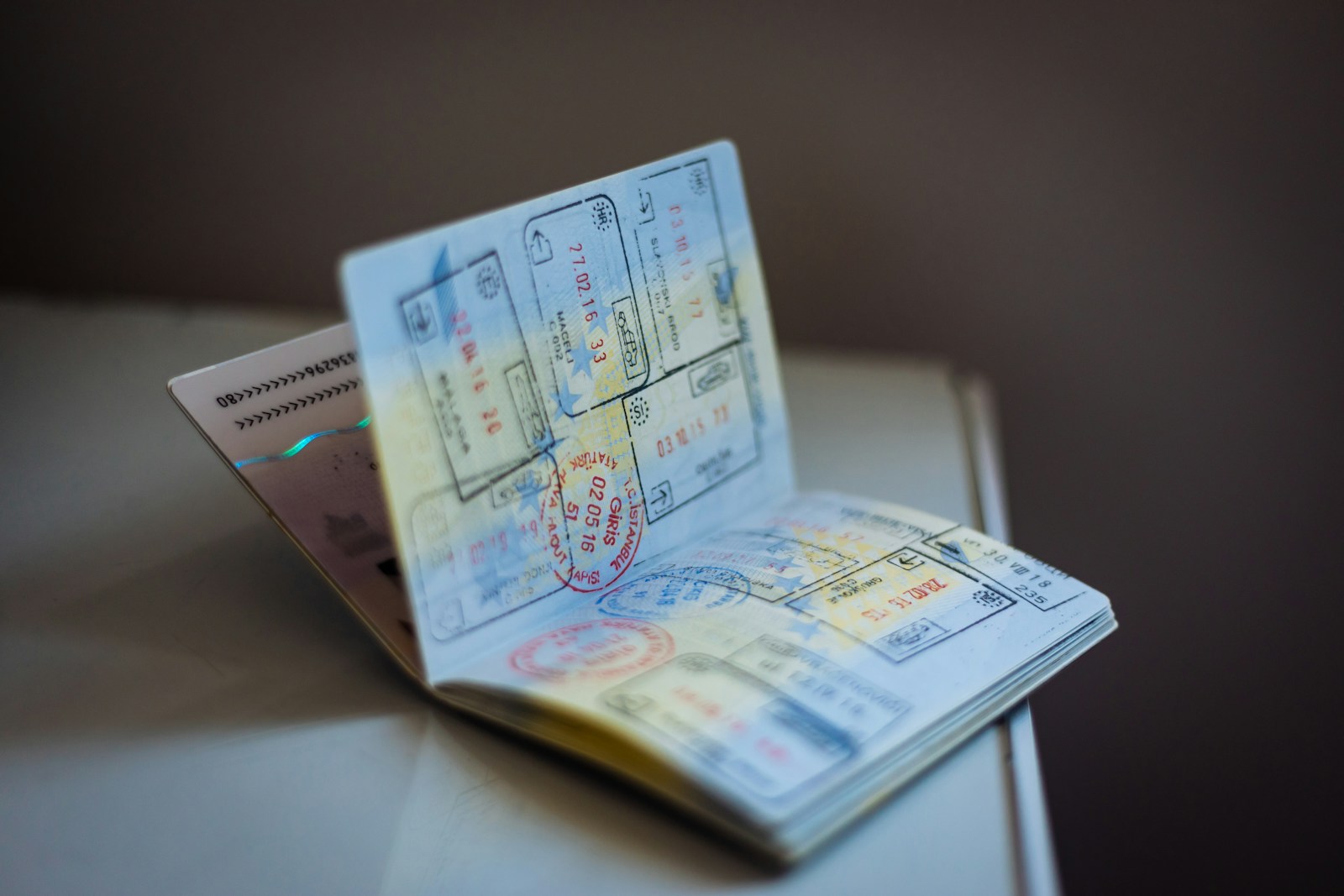
Most inventions on this site are things you can hold: the lightbulb, the barcode, the safety pin. The visa is different. It is a piece of administrative technology — an idea, a procedure and a stamp — and yet it shapes the lives of more people every day than almost any gadget. Whether you can take a job in Dubai, study in Berlin, or spend two weeks in Thailand is decided by a document whose name literally means "it has been seen".
Like most great inventions, the visa was not invented once. It was invented, forgotten, reinvented in a panic, standardised by committee, and then almost entirely rebuilt in software. This is that story.
What the word "visa" actually means
The English word arrived around 1831, borrowed from French. The French, in turn, had clipped it from the Latin phrase charta visa: "paper that has been seen". The root is the verb videre, to see, which is also why the old-fashioned mark "vidé" still appears on some European official documents.
That etymology tells you precisely what the original invention was. A visa was never the travel document itself. It was an endorsement on someone else's document — a foreign official's note, later a rubber stamp, recording that he had examined your papers and had no objection to your arrival. The passport says who you are; the visa says a second government has looked at you and said yes. Everything that followed, from the Schengen sticker to the electronic travel authorisation, is a variation on that one idea.
The ancestors: letters of safe passage
The need to prove you had permission to travel is far older than the word. The earliest surviving account is in the Hebrew Bible. In the Book of Nehemiah (chapter 2, verses 7–9), dated to roughly 450 BC, Nehemiah, a cupbearer to the Persian king Artaxerxes I, asks for "letters to the governors beyond the River, that they may let me pass through until I come to Judah". The king provides them, along with an armed escort. Historians routinely cite this as the first recorded passport. It is equally the first recorded visa, because the letters were addressed to the officials of the territories he would cross, asking them to let him through.
Other ancient states built similar machinery. In Han dynasty China (202 BC – 220 AD), travellers needed a zhuan, a pass that had to be shown at control points between counties and at the frontier. Kautilya's Arthashastra, the Indian statecraft manual from around the 3rd century BC, describes passes issued for a fee of one masha to anyone entering or leaving the kingdom, and prescribes fines for travelling without one. The medieval Islamic caliphate issued the bara'a, a receipt proving you had paid your taxes, without which you could not move between regions.
Medieval Europe ran on the safe conduct: a sealed letter from a ruler guaranteeing protection to a named person travelling through his lands. England's Safe Conducts Act of 1414, passed under Henry V, is the earliest mention of such documents in an Act of Parliament. It is often called the first passport law, though its actual purpose was to make the breach of a safe conduct an act of treason. Crucially, these were documents that a foreign ruler granted to a traveller, not documents the traveller's own government issued. In spirit, the safe conduct is the direct ancestor of the visa rather than the passport.
The first modern visas: Europe's police states
The visa in its recognisably modern form — an official endorsement on a national passport — emerged in the 17th and 18th centuries, as European monarchies tightened their grip on who crossed their borders. The word "passport" itself probably refers to the porte, the gate of a walled city, rather than a seaport: you needed papers to pass the gate.
By the era of the French Revolution and Napoleon, a traveller crossing Europe could expect to have his passport "viséd" at each frontier, and often at each major town inside it. The stamp, the signature and the fee were all there. What was missing was any international agreement on what a passport should look like or what a visa should say. Every state improvised.
The great abandonment: the 19th century
Here the story takes a turn that surprises most people. Having invented the visa, Europe threw it away.
The railway made the old system unworkable. A stagecoach could be stopped and its passengers' papers inspected at every border post; a train carrying hundreds of passengers across three countries in a day could not. Governments that tried were overwhelmed. France effectively abandoned passport controls in the 1860s; Germany's North German Confederation dropped them in 1867, and most of Western Europe followed. By the 1880s a British subject could travel from London to Constantinople without once producing a passport, let alone a visa. The only major exceptions were the Russian and Ottoman Empires, whose insistence on papers was regarded in the West as evidence of backwardness.
An International Labour Organisation report in 1922 looked back on the period with something like nostalgia: "Migration was generally speaking, unhindered and each emigrant could decide on the time of his departure, his arrival or his return, to suit his own convenience." Sociologist John Torpey, in his definitive study The Invention of the Passport, calls this the 19th-century "trend toward freedom of movement". For half a century the visa was, in practice, an obsolete technology.
The reinvention: 1914
The First World War reinvented the visa in a matter of weeks. In August 1914 France, Germany and Italy reimposed mandatory passports, citing the need to catch spies and control manpower. Neutral Spain, Denmark and Switzerland followed to keep out undesirables from the belligerents. Britain passed the British Nationality and Status of Aliens Act in the same year and introduced the first modern British passport booklet in 1915.
The United States, which had never seriously controlled its borders by documentation, began requiring all foreigners to obtain a visa from an American consul before departure in 1917, as a wartime measure. The Passport Control Act of 22 May 1918 made that permanent, and Executive Order 2932 of August 1918 wrote the regulations. Every wartime "temporary" measure survived the peace.
This is the real birth date of the visa as we experience it today. Before 1914 a visa, where it existed at all, was something you obtained at the border. After 1918 it became something you applied for in advance, at a consulate, with forms and fees and the possibility of refusal — a system American historians later named "remote control", because the decision about who could enter was made thousands of miles from the actual border.
Standardised by committee: the League of Nations, 1920
The post-war tangle of incompatible documents was so bad that the League of Nations made it one of its first practical projects. The Paris Conference on Passports & Customs Formalities and Through Tickets, held from 15 to 21 October 1920, is the moment the modern passport was invented as a global standard: the booklet format, the 32 pages, the bilingual text, the photograph, the validity period. Almost every passport in the world today descends from the 1920 Paris template.
The conference also had strong views on visas. Delegates agreed that restrictions were damaging to international relations and recommended abolishing exit visas outright, capping visa fees, and issuing visas valid for multiple entries. But, in the conference's own words, "security concerns prevented the total abolition of restrictions and the complete return to pre-war conditions". Follow-up conferences in Rome (1924) and Geneva (1926) went further: the Rome delegates stated that "the necessity of obtaining passports should be abolished as soon as possible", and the Polish delegate at Geneva, Franciszek Sokal, proposed that all League members simply scrap passports altogether. He lost. The visa, once reinvented, proved impossible to un-invent.
The 1920s also gave us the first humanitarian travel document. The Nansen passport, devised by Norwegian explorer Fridtjof Nansen in 1922 for stateless Russian refugees, was recognised by over fifty governments and carried its own visa arrangements — proof that the visa system could be bent toward compassion as well as control.
America invents the quota visa: 1924
The next major leap came from the United States. The Immigration Act of 1924 (the Johnson-Reed Act) introduced national-origin quotas, and enforced them through the consular visa. For the first time, the visa was not a simple "seen and approved" stamp but a numbered, allocated, category-specific permission, issued against a fixed annual total. Prospective immigrants were interviewed and accepted or rejected at the consulate nearest their home, far from American shores. Political scientist Aristide Zolberg estimated there were 78 applicants for every quota slot available to Southern and Eastern Europe.
This is the ancestor of every modern visa category. The idea that a visa has a type (tourist, student, work), a numerical ceiling and an eligibility test is a 1924 invention, and it spread around the world over the following decades.
The work visa and the student visa
Work visas as a distinct class grew out of the same post-war controls. Britain's Aliens Order of 1920 required foreigners to hold a work permit issued to the employer before taking a job, a model that much of the Commonwealth copied. South Africa had been an early mover: the Immigrants Regulation Act of 1913, passed three years after Union, gave officials sweeping discretion over who could enter and on what terms, and its descendants — the Aliens Act of 1937, the Aliens Control Act of 1991 and finally the Immigration Act 13 of 2002 — built out the visa categories South Africans and visitors to South Africa use today.
The United States split its work visas into lettered categories in the Immigration and Nationality Act of 1952, which created the original H-1 visa for workers of "distinguished merit and ability". The Immigration Act of 1990 replaced it with the H-1B, capped at 65,000 a year, and set the template for the skilled-worker visa that dozens of countries have since imitated — including South Africa's critical skills work visa, introduced by the Immigration Amendment Act of 2011 and overhauled under the points-based system gazetted in October 2024, the same notice that created the country's first remote-work visitor visa for foreign "digital nomads" earning at least R1 million a year.
Student visas arrived with the post-war boom in international education; the US J-1 exchange visitor visa dates from the Fulbright-Hays Act of 1961, and the F-1 student visa from the 1952 Act.
Un-inventing the visa, partly: waivers and Schengen
By the 1980s, mass tourism had recreated the 19th-century problem. Consulates were drowning in applications from travellers who posed no conceivable risk. Two inventions answered it.
The first was the visa waiver. The US Immigration Reform and Control Act of 1986 created the Visa Waiver Pilot Program, initially for up to eight friendly countries, allowing their citizens to visit for 90 days without a visa. It became permanent in 2000 and today covers around forty countries. South Africa has never been admitted, which is why South African passport holders still apply for a full US visitor visa.
The second was the shared visa. On 14 June 1985, five European states signed the Schengen Agreement aboard a boat on the Moselle river, agreeing to dismantle their internal borders. The 1990 implementing convention created the uniform Schengen visa: one application, one sticker, valid across every member state. Checks were lifted on 26 March 1995. For a traveller from Johannesburg or Cape Town, a single Schengen visa now opens 29 countries — which is exactly why the Schengen application is among the most common jobs handled by specialist services such as GetVisa, which prepares Schengen, UK, US, Canadian and Australian applications for South African passport holders and publishes free visa requirements for all 197 countries.
The visa goes digital: 1996 to today
The last great reinvention removed the stamp entirely. On 11 September 1996 Australia trialled the Electronic Travel Authority (ETA) in Singapore, for Singaporean and American passport holders flying Qantas or Singapore Airlines. The visa was no longer a mark on a page; it was a record in a database, linked to the passport number and checked by the airline at check-in. Australia became the first country in the world to issue visas electronically, and the model spread: the US ESTA (2009), Turkey's e-Visa (2013), India's e-Visa (2014), Canada's eTA (2016), and the EU's long-delayed ETIAS.
South Africa joined the movement late but decisively. The Department of Home Affairs piloted an e-visa in 2019 and launched it properly in 2022, then on 18 September 2025 announced a full Electronic Travel Authorisation system, built on machine learning and biometrics, which went live for G20 delegates in October 2025 and for visitors from China, India, Indonesia and Mexico the following month. By the count on GetVisa's own database, South Africans can now enter 60 countries visa-free and a further 33 on an eVisa or ETA — roughly half the world without ever visiting a consulate.
Even so, the other half still runs on something Nehemiah would recognise: a letter, an official, a judgement, and the very real possibility of "no". Modern refusals turn on the same questions the consuls of 1924 asked — are your finances real, is your itinerary coherent, will you go home? — which is why the most useful innovation in the field may not be technological at all, but the specialist consultant who prepares the application properly the first time.
Why the visa matters as an invention
Inventors like to think in terms of patents, prototypes and products. The visa is a reminder that some of the most powerful inventions are procedures. Nobody patented it. No single person invented it. It was assembled over 2,500 years out of letters of safe conduct, rubber stamps, committee resolutions and, eventually, database records. It was abandoned for fifty years when a better technology (the railway) made it impractical, and resurrected in weeks when circumstances (the war) changed.
That is a pattern worth studying. Inventions do not succeed because they are clever; they succeed because they solve the problem a society has right now. The visa solved the problem of a frightened world in 1914, the problem of an overwhelmed one in 1986, and the problem of a digital one in 1996. Each time, it changed shape to fit. For the inventor, the lesson is the same one the barcode and the lightbulb teach: watch the need, not the object.
Key dates in the invention of the visa
- c. 450 BC — Nehemiah receives letters of passage from Artaxerxes I (Nehemiah 2:7–9).
- 1414 — England's Safe Conducts Act, first statutory mention of travel documents.
- 1831 — The word "visa" (from Latin charta visa, "paper that has been seen") enters English.
- 1860s–1914 — Most of Western Europe abolishes passport and visa controls.
- 1914–1918 — Wartime reintroduction; US requires consular visas from 1917, made permanent in 1918.
- 1920 — League of Nations Paris Conference standardises the passport and visa formats.
- 1924 — US Immigration Act creates the quota visa and "remote control" at consulates.
- 1985/1995 — Schengen Agreement signed; uniform Schengen visa in force.
- 1986 — US Visa Waiver Pilot Program.
- 1990 — H-1B skilled-worker visa created.
- 1996 — Australia issues the world's first electronic visa (ETA).
- 2022–2025 — South Africa launches its e-visa, then an Electronic Travel Authorisation system.
Sources and further reading
- John Torpey, The Invention of the Passport: Surveillance, Citizenship and the State (Cambridge University Press, 2000; 2nd ed. 2018).
- League of Nations, Paris Conference on Passports & Customs Formalities and Through Tickets, resolutions, October 1920.
- Migration Policy Institute, "A Century Later, Restrictive 1924 U.S. Immigration Law Has Reverberations in Immigration Debate".
- US National Archives, "Department of State Visa Records in the National Archives".
- Congressional Research Service, "Visa Waiver Program" (RL32221).
- South African History Online, "The Immigration Regulation Act is passed in South Africa" (14 June 1913).
- Department of Home Affairs (South Africa), Remote Work Visa requirements, 9 October 2024; ETA announcement, 18 September 2025.
- Online Etymology Dictionary, "visa".